Operations & Billing
How Eye Hospitals Can Reduce OPD Waiting Time
Reduce eye-hospital OPD waiting time through visible queues, accountable handoffs, dilation tracking, deliberate diagnostics, and reliable measurement.
In this article
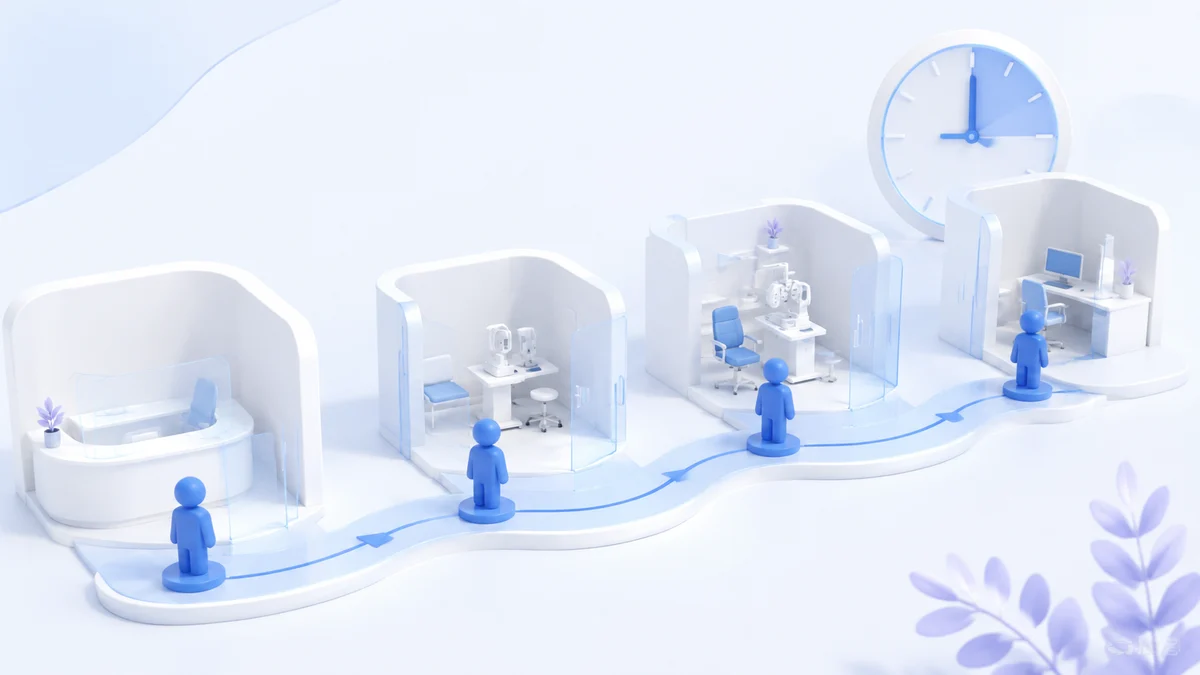
Eye hospitals can reduce avoidable waiting by making every patient stage, owner, handoff, exception, and completion signal visible. The aim is not to rush clinical care; it is to remove uncertainty between registration, optometry, dilation, consultation, diagnostics, billing, and follow-up.
Key takeaways:
- Measure time by stage instead of relying on one total visit number.
- Distinguish queue position from completed clinical work.
- Make dilation, rechecks, and diagnostic handoffs explicit.
- Improve one bottleneck at a time using verified timestamps.
Map the actual journey
Start with the paths patients really follow. A routine consultation, standalone investigation, emergency visit, dilated examination, and doctor-requested recheck do not have the same sequence. Record entry and exit conditions for each stage.
Give every waiting patient an owner
A queue should show who is waiting, why, since when, and which staff member or department is responsible. Ownership must survive browser refreshes and shift changes, while supervisor reassignment remains attributable.
Treat dilation as a visible sub-state
Dilation creates clinically necessary waiting. Capture the start time, agent, expected review point, exception reason, and return path. Do not count the patient as lost simply because they are temporarily outside the active optometry chair.
Separate advice from an operational investigation
When a doctor advises OCT or fundus photography, the advice belongs in the clinical plan. It does not automatically create an appointment, order, bill, or diagnostics queue item. The hospital deliberately starts its chosen operational workflow; a booked standalone investigation can then move through financial clearance, diagnostics, completion, and review.
Measure permanent evidence
Current queue tells staff where a patient is now. It does not prove which modules were completed. Operational reporting should use reliable start, completion, and exception timestamps rather than reconstructing the journey from the final queue label.
A practical improvement cycle
- Establish a baseline for each stage and visit type.
- Find the longest controllable delay.
- Observe the handoff and identify the information gap.
- Change one routing, staffing, or communication rule.
- Compare the same stage and visit type again.
- Check for downstream congestion before adopting the change.
Coordinate booking channels with the same schedule
Quick booking, scheduled appointments, online bookings and configured kiosk access should all respect the doctor's available capacity. The hospital can reserve selected times for online booking while retaining the rest for reception. A separate website calendar that ignores front-desk bookings can create congestion before the patient arrives.
Distinguish the doctor consultation time from the arrival time. If registration and workup happen first, the patient needs a clear arrival instruction and the front desk needs the booked consultation time. A consultation slot is a scheduling commitment; it should not be presented as a guarantee that every clinical step will finish at an exact minute.
Find the delay before changing staffing
Suppose workup starts promptly but completed patients wait for the doctor. Adding more registration capacity may increase that queue. Review the interval from workup completion to consultation start, the number waiting and the available doctors together. Change one part of the process, then check whether the delay moved elsewhere.
Use the online booking guide to align access channels and the operational KPI definitions to measure the result. These are improvement methods to test locally, not a claim of a particular waiting-time reduction.
Frequently asked questions
Should every patient follow one fixed route?
No. The system should support documented variations while preserving valid state transitions, ownership, exceptions, and completion evidence.
Does faster flow mean shorter clinical examinations?
It should not. Flow improvement targets administrative delay, unclear ownership, repeated entry, and avoidable handoff gaps.