Operations & Billing
Eye Hospital Billing Software: An OPD Workflow Checklist
Evaluate eye hospital billing software across pricing, drafts, payments, discounts, receivables, cashless panels, refunds, receipts, laterality, and reporting.
In this article
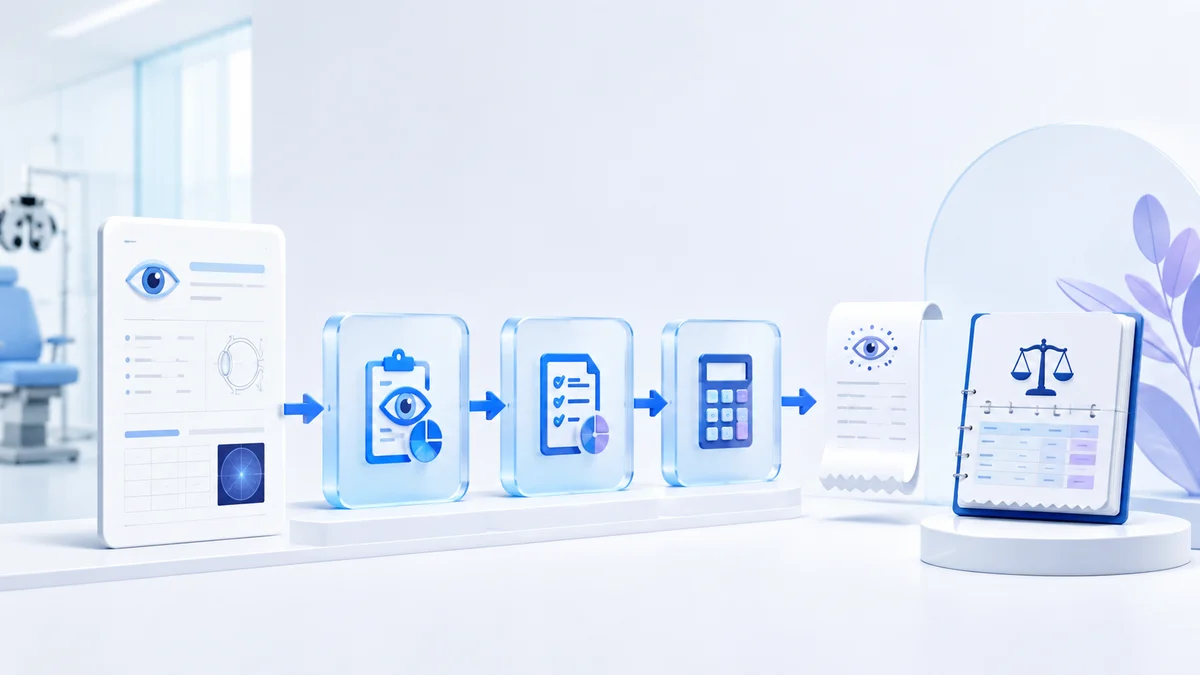
Eye hospital billing software should preserve the connection between the patient, encounter, service, eye, approved price, invoice state, payment, panel receivable, receipt, refund, and report. Financial convenience should not weaken server authority or audit history.
Key takeaways:
- Service identity and price should be verified by the server.
- Draft, receivable, partial, settled, and voided states have different meanings.
- Patient payment and panel receivable are separate obligations.
- Paid cancellation should preserve the original tender and refund history.
Authoritative services and laterality
Each billable service should have stable identity, display name, applicable rate, and laterality where relevant. OD, OS, and OU should remain structured data rather than being embedded ambiguously in free-text labels.
Drafts are not revenue
An unpaid draft represents unfinished billing work. It should not automatically become billed revenue or patient accounts receivable. Deferred patient payment should require an authorized decision, service-delivery confirmation, reason, and due date.
Discounts and partial payments
If a maker-checker policy is enabled, a pending discount should block payment until an eligible reviewer decides it. Partial payment should preserve the remaining balance without pretending the invoice is settled.
Cashless panel accounting
Clinical clearance under an authorized cashless panel may let the patient continue, while the hospital still has an outstanding panel receivable. The software should not record a patient payment or receipt when no money moved.
Cancellation and refund
If payment was collected, cancellation should use a server-authoritative refund workflow that retains the original tender, creates the appropriate credit or refund history, and closes the appointment consistently. A cashless claim cancellation is not a patient refund unless the patient actually paid.
Reporting checks
Reconcile revenue, receipts, credit notes, patient receivables, and panel claims to their canonical records. OPD financial reporting should not be reconstructed from cash registers or till activity.
Test the bill through a complete visit
Use a consultation with a later, separately booked investigation. Check that the two services keep their own identity and that billing can explain which service each amount belongs to. Then test a partial payment, an approved discount and a cancellation before clinical work begins.
| Scenario | Record to inspect |
|---|---|
| Patient pays part of the charge | Receipt plus the remaining patient balance |
| Panel covers part of the service | Patient payable and panel receivable separately |
| Payment request is retried | One recorded payment for the same transaction |
| A paid visit is cancelled | Original invoice and attributable refund or credit history |
| Website payment confirms a visit | Appointment, settled charge and linked receipt |
Ask the cashier to explain each final balance from the records on screen. If that explanation requires a spreadsheet or a verbal adjustment, record the gap during evaluation. The online appointment guide covers the website-to-front-desk handoff; the cashless claims checklist covers panel documentation.
These scenarios describe software acceptance checks. The hospital's billing and finance team should define its accounting treatment and approval policy.
Frequently asked questions
Can a cashier type a different price at settlement?
Client input should not be authoritative. The server should resolve the approved service and rate and reject invalid or stale pricing.
Is a zero patient balance always a settled invoice?
No. A cashless panel may reduce patient payable to zero while the panel receivable remains pending.