Implementation
Scaling a Multi-Branch Eye Hospital Without Fragmenting Records
Scale a multi-branch eye hospital EMR with patient identity, branch access, staff assignments, workflows, authorized reporting, migration, and auditability.
In this article
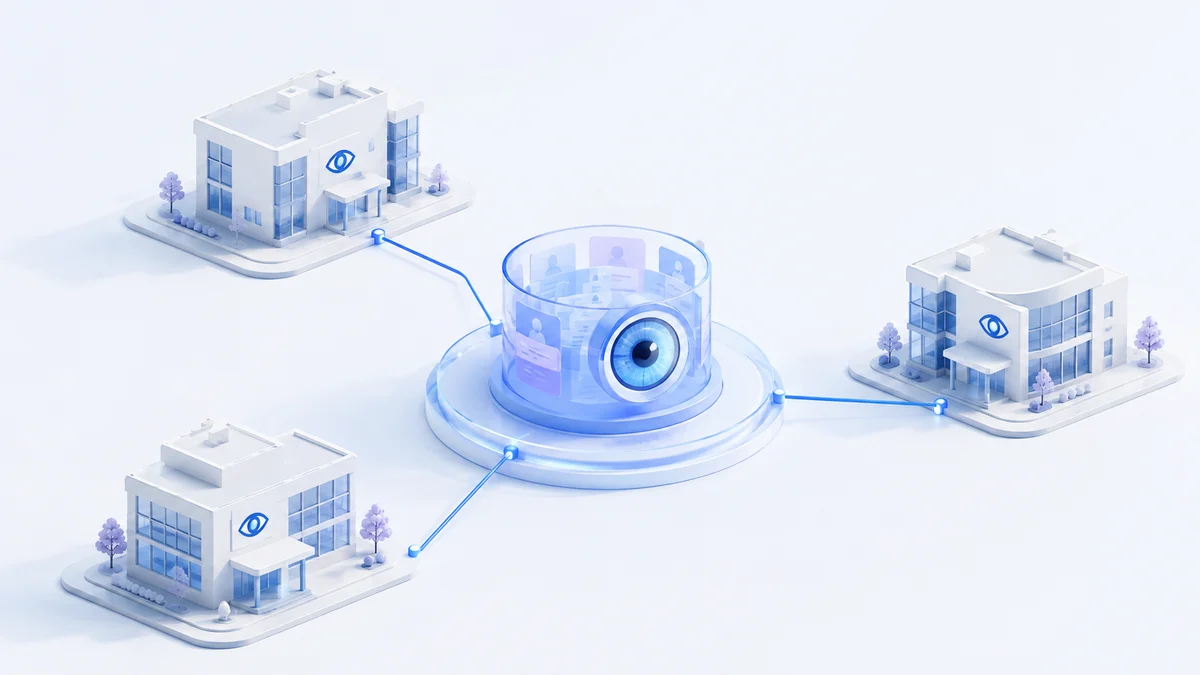
A multi-branch eye hospital needs one governed patient identity and longitudinal clinical history while keeping each location's schedules, queues, billing, stock and surgery operations correctly scoped. Central visibility must not become unrestricted cross-branch access.
A multi-branch eye hospital EMR refers to a system that supports several operating locations inside one hospital organization with explicit branch ownership, authorized staff access and controlled cross-branch reporting.
Key takeaways:
- Keep hospital identity and branch ownership as separate boundaries.
- Resolve staff access from verified roles and assignments.
- Do not copy operational state when a user switches branches.
- Make cross-branch reporting an explicit authorized action.
Start with one patient identity
A returning patient should not receive a new identity merely because the next visit occurs at another branch. Define the hospital-wide MR policy, duplicate-resolution process and rules for historical identifiers before opening the second location.
Clinical history can remain longitudinal while individual encounters retain their branch of origin. That combination lets a clinician understand chronology without erasing where the care occurred.
Give every operational record a branch owner
Appointments, queues, invoices, receipts, schedules, surgery cases, inventory movements and operational reports need an effective branch. A record without branch ownership must not become visible everywhere by default.
Branch ownership should be immutable after creation except through a narrowly governed correction process. Switching the navigation branch changes the authorized query and write scope; it should not rewrite existing records or synchronize operational decisions between locations.
Assign staff deliberately
Receptionists, optometrists, doctors, diagnostics staff, counsellors, operations teams and administrators need different access. A staff member assigned to Branch A should not gain Branch B simply by changing a browser value.
Store active branch assignments, validate the user's default branch, and make role or branch changes server-authorized and auditable. Hospital administrators may need broader hospital visibility, but another hospital must remain outside the boundary.
Separate local operations from authorized oversight
Some decisions are local: today's queue, provider availability, room use, branch pricing configuration, diagnostics workload and OT schedule. Leadership reporting may need to aggregate across locations.
These are different paths. Local screens should filter by the active authorized branch. Cross-branch analytics should be a deliberate administrator view with clear branch dimensions, not the accidental result of a missing filter.
Migrate before opening the next branch
Legacy operational records may lack a branch field. Migration should be resumable, idempotent and non-destructive: assign only missing ownership, preserve existing branch values, record progress and advance to strict isolation only after every in-scope collection has been checked.
For clinical-history migration details, use the ophthalmology EMR data migration checklist.
Test with real cross-branch scenarios
Before launch, verify that:
- Assigned staff see only permitted branches.
- An administrator can view authorized hospital-wide reports.
- A branch switch changes scope without copying data.
- Existing records retain their original branch.
- A suspended branch cannot receive new operational work.
- Historical records remain readable without becoming globally visible.
Rehearse a returning patient at another branch
Test a patient whose earlier consultation was at Branch A and next appointment is at Branch B. Authorized clinicians should be able to understand the earlier history, including its origin. The new appointment, local doctor schedule, bill and receipt should belong to the branch providing the new visit.
Next, test a staff member who works at both locations and a receptionist who works at only one. Changing branches should change the available operational context according to their assignments. Shared credentials make this harder to verify; use individual accounts with attributable actions.
| Shared across the hospital when authorized | Kept in the responsible branch |
|---|---|
| Patient identity and permitted clinical history | Appointments and daily queues |
| Agreed clinical terminology | Provider schedules and room allocation |
| Leadership reporting with branch dimensions | Invoices, receipts and stock movements |
Use the NIST Cybersecurity Framework as a general governance reference when assigning access and response responsibilities. It is not evidence that any particular deployment has passed a security assessment. Include branch-specific online availability in the appointment booking acceptance test.
Frequently asked questions
Should every branch have a separate patient number?
Not necessarily. A hospital-wide patient identity can coexist with branch-owned encounters. The policy should prevent duplicates while preserving the location attached to each episode of care.
Does centralized reporting mean every employee can see every branch?
No. Aggregation should be explicitly authorized. Department staff can remain branch-limited while approved leadership roles receive a controlled cross-branch view.
See the wider Iris ophthalmology EMR journey for the clinical and operational stages that branch governance must protect.